NEW: Listen to this story
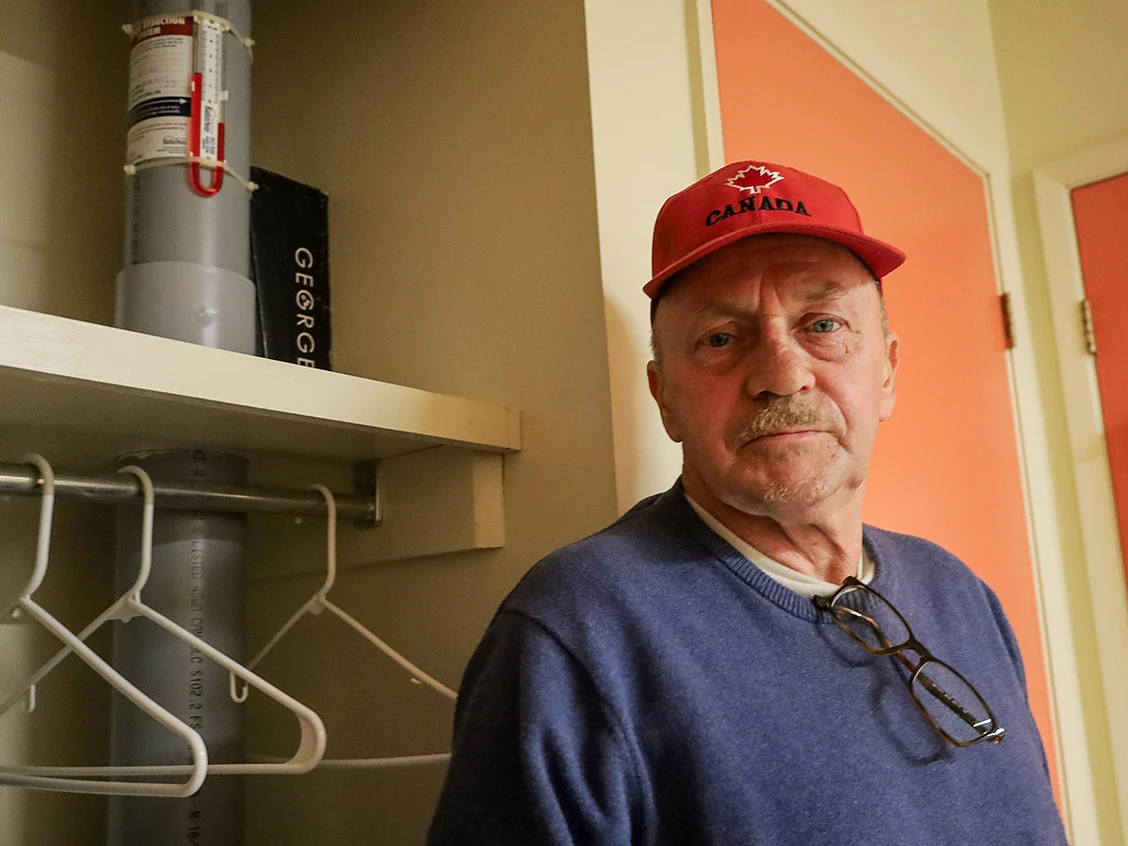
Eleanor Hubley Manor is a modest, beige one-storey apartment building just off a highway interchange near Halifax. As part of the province’s subsidized housing network, it is home to about eight tenants who, for reasons ranging from bad health to poverty, have little choice about where they live.
The residence is also plagued by dangerously high levels of carcinogenic radon gas, according to provincial testing data spanning almost 10 years, which found the persistent presence of Canada’s second-leading cause of lung cancer after smoking.
In 2008, all 10 units in the building tested high for radon, with some reaching levels more than three times above Health Canada’s safety guideline. Testing in 2013 and 2017 (the last year for which data is available) showed radon levels remaining in excess of the safety standard.
Many tenants, such as Michael Murphy, say they were never told the manor’s radon levels exceeded the national guideline.
“(Lung cancer) will sneak up on you,” said Murphy. “They should be leaving papers or notes or something to tell the people.”
Across Canada, tens of thousands of public housing residents have been exposed to elevated levels of radon gas — some for years without their knowledge — according to more than 20,000 test results obtained by the Investigative Journalism Bureau.
Cross-referenced with census and housing data, this means as many as 45,000 social housing residents are likely to have been exposed to radon levels higher than Health Canada’s guideline.
The danger isn’t limited to social housing. The newly obtained IJB data builds on other research on population exposure in general, led by Aaron Goodarzi, a Canadian radon researcher based at the University of Calgary.
A cross-country study he led in 2024 showed about one in five residential properties — 18 per cent — have radon levels at or above the current national safety guideline of 200 becquerels per cubic metre (Bq/m³), a measurement of radioactivity in the air. An additional 24 per cent of homes have radon levels between 100 Bq/m³ (the safety guideline of the World Health Organization) and Canada’s less stringent national guideline.
And there are no “radon-free” areas of the country, that study found.
Radon — an invisible, odourless and radioactive gas that emanates from soil and gets trapped in homes, particularly in basements — is the leading cause of lung cancer among non-smokers in Canada. It is responsible for an estimated 3,200 lung-cancer deaths in Canada each year, according to Health Canada.

“The (radon) risk is real, present, and demonstrated,” said Goodarzi, who is director of Evict Radon, a national research project dedicated to understanding and preventing radon exposure. He reviewed the social housing data that the IJB obtained through freedom of information requests and informal requests to social housing agencies.
“If a social safety net is intrinsically dangerous, that defeats the point of a social safety net.”
The true scope of the threat isn’t known for the more than one million Canadians in publicly subsidized housing because testing across Canada is not required and doesn’t happen across large swaths of the country.
But the 20,619 radon test results the IJB obtained from across Canada showed that eight per cent exceeded Health Canada’s national safety guideline of 200 Bq/m³. At least 21 per cent exceeded the World Health Organization’s tougher international safety guidelines of 100 Bq/m³, but the specific data was not always collected, meaning the full scope of the threat is not known.

Yet remediation work to address radon seepage in public housing would actually be cheaper on the public purse than ignoring it, say researchers.
Identifying and treating stage one lung cancer in a single patient costs between $30,000 and $50,000. Those costs climb for treatments of stage two, three, and four cancer and could add up to around half a million dollars per person, said Dr. Alison Wallace, a thoracic surgeon at Dalhousie University who has studied the connection between radon exposure and lung cancer.
The cost of mitigating radon in one single-family home is about $3,000. Remediating apartment buildings can cost more than $10,000, but that fixes the problem for tens of households at once. The fix often involves sealing cracks in foundations and venting the gas outside the building before it has a chance to seep inside.

“It’s something you can eliminate to reduce contributing to lung cancer for a fraction of the cost of treatment,” said Wallace. “I think it should be mandatory to create a safe place for people to live.”
Unlike many private homeowners or landlords, social housing residents often don’t have the ability or means to test the air quality in their building or make repairs to address radon.
“Not much you can do about it if you need a place to live,” said Alishia Brigley, a resident at Eleanor Hubley Manor. “I’ve been in this building a long time.”
ELEANOR HUBLEY MANOR
Reporters requested radon test results from 65 municipal, regional and provincial public housing authorities across Canada. Only 13 government housing providers — in British Columbia, Yukon, Saskatchewan, Manitoba, Ontario, Québec, Nova Scotia, New Brunswick and Prince Edward Island — provided results. The rest of the housing authorities — more than 50 — said they had never tested their units, or failed to provide data.
No legislation in Canada explicitly compels public housing authorities to test units for radon. But Health Canada does encourage social and municipal housing providers to test for radon proactively.
“Addressing radon in social housing is an ethical and socially responsible action for municipalities to take,” reads a public statement on Health Canada’s website.

Across the country, there is a patchwork of radon testing policies in social housing.
In British Columbia, for example, test results in the Interior and Northern districts, along with portions of Vancouver Island, show 10 per cent of housing units exceeded Health Canada’s guidelines. BC Housing did not provide data on units that exceeded the WHO guideline or mitigation measures.
The Capital Region Housing Corp., which covers the capital, Victoria, does not conduct radon testing in its public housing units because “previous provincial testing has shown the area to have low residential Radon levels below 200 Bq/m³,” spokesperson Jamie Gripich said in a written statement.
B.C. Ministry of Housing spokesperson Tasha Schollen said the ministry is “committed to transparency and accountability,” and “reaffirms its commitment to mitigating and repairing any site where radon levels are above Health Canada guidelines.”
The Prairies have some of the highest documented residential radon levels in the world.
But Corinne Berger, a freedom of information manager with the Alberta government, said in an email that the province “does not have a dedicated program related to radon testing in all social housing locations.”
Amber Cannon, a public housing tenant in Calgary who works with people living in poverty, says she expects to live in public housing for the rest of her life due to health conditions that limit her mobility.
She was overjoyed when she finally found a safe and stable place to live two decades ago. Now, she’s concerned that she may have been breathing deadly radon this whole time.
“I’m trying to stay very level-minded about this because I don’t know the radon levels in my unit,” she says. “It just makes me very sad. I wish the Government of Alberta cared more.”
The province said it encourages voluntary testing and suggested that tenants concerned about radon levels in their homes should contact their local housing operator or landlord.
In a written statement, Calgary’s public housing agency spokesperson Kaila Lagran said radon testing “is not a legislated requirement.”
Edmonton’s public housing authority also said it has no radon testing protocols but added, “Civida (the current largest social housing provider for the city) is committed to ensuring that future capital developments with basements be designed with radon collection, in alignment with current building code.”
Heather Barlow, press secretary for the Office of the Minister of Seniors, Community and Social Services, said health and safety is “a top priority for Alberta’s government and radon is among many environmental hazards we take seriously.” She suggested tenants in government-supported housing could contact Alberta Seniors, Community and Social Services “to share their concerns anonymously.”

Ontario has more than half of Canada’s social housing units, where an estimated 472,000 people live. But only a tiny percentage can know whether their health is being impacted by elevated radon levels.
Toronto Community Housing Corp., Canada’s largest social housing provider with nearly 95,000 tenants in more than 40,000 units in 2024, doesn’t conduct radon testing.
“We’re interested in hearing more from the experts that you spoke with about radon testing,” Nadia Gouveia, TCHC’s chief operating officer, said in a statement. “TCHC is committed to meeting and, where possible, exceeding the standards for keeping our communities safe.”
Ottawa Community Housing Corp. — home to about 33,000 tenants in 15,000 homes — said landlords are not required to conduct radon testing, but OCHC spokesperson Chantal Genova added, “We value ongoing dialogue exploring ways to further improve our practices and the well-being of tenants.”
Greater Sudbury’s housing department wrote in response to a request for testing data in 2023 that “radon testing is not mandated and therefore not something that Sudbury housing has undertaken at this time.” It reiterated in August 2025 that “housing facilities are not scheduled for testing at this time.”
The province’s Residential Tenancies Act doesn’t explicitly spell out radon testing requirements. It does, however, require landlords to ensure rental units comply with health standards.
“Publicly owned housing should be tested … by the public entity that owns them,” said Theresa McClenaghan, executive director of the Canadian Environmental Law Association. “They should be much more proactive about something that’s a clearly understood health hazard.”
“If we have the tools and resources to help otherwise disadvantaged people that in no way have control over that particular environment, we have a social obligation to do so,” said Goodarzi.
Tribunals in Ontario and Quebec have found that renters in general should be protected from high radon levels.
A 2017 ruling in Ontario’s Landlord and Tenant Board found a private landlord breached the province’s Residential Tenancies Act by failing to protect a unit from “moisture and radon gas.” The landlord was ordered to remediate the unit for radon and pay the tenant a “100% rent abatement” for the radon contamination and other structural issues.
In the United States, the Department of Housing and Urban Development requires radon testing as a condition for multifamily social housing developments receiving federal funds.
Ontario Ministry of Municipal Affairs and Housing spokesperson Justine Teplycky said in a statement that Ontario’s building code, which only requires mitigation in a few historically radon-high areas of the province, is enforced locally. As of 2025, Ontario’s building code required all new residential buildings to include a radon mitigation rough-in — groundwork that makes future radon remediation easier and cheaper.
No safe level of radon
Hundreds of housing units across the country known to contain high levels of radon are considered safe and remain unremediated because of a discrepancy between Canada’s safety guidance and the international standard recommended by the WHO based on more recent scientific evidence.
Health Canada established its 200 Bq/m³ radon safety guideline in 2007 — a decision that “balanced health risk reduction with socio-economic considerations, recognizing that the burden of mitigating would typically fall to individual homeowners,” Kelley Bush, Health Canada’s radon outreach manager, said in a statement.
The statement also says there is no safe level of radon and that the 200 Bq/m³ guideline is not a “safe” threshold “but a level at which action is recommended, and that ultimately it is the choice of each homeowner to decide what level of radon exposure they are willing to accept.”
The Canadian guideline has not changed despite a steadily growing body of research showing prolonged exposure to just half of that level can lead to a significant increase in lung cancer risk. WHO set its radon safety recommendation at 100 Bq/m³ in 2009.

Health Canada’s own study in 2012 estimated that remediating every home in Canada to the WHO standard would save 700 more lives than simply mitigating homes for radon based on its own guideline.
Given only about 10 per cent of Canadian homes have been tested for radon, and mitigation rates are similarly low, “Health Canada’s focus is on raising awareness and getting every Canadian to test, to enable decisions on action, rather than redefining the action level,” said Bush.
The IJB found most social housing providers don’t adhere to the international guideline. Asked whether they mitigate housing units with radon levels over 100 Bq/m³, 10 government bodies that operate social housing all said that they follow Health Canada guidance.
Grassroots action for more testing and remediation
In the absence of radon testing regulations, some communities in Canada are taking it upon themselves to act.
In Newfoundland and Labrador, one public housing tenant’s concerns about radon led to a province-wide testing program. The tenant’s two children lived in the basement of their home, where the threat of radon is typically the highest.
In response, the Newfoundland and Labrador Housing Corp. tested and remediated the tenant’s housing unit in late 2022 and began testing the rest, said Janet Noftall, environmental manager for the NLHC.
It has now tested more than 100 homes. About 23 per cent exceeded Health Canada’s safety guideline.
“Why wait … when we know we should be doing it anyway?” said Colleen O’Keefe, NLHC’s director of engineering. “If you’re choosing not to do it, you’re just kicking the can down the street. So, we want it to be proactive and get ahead of it and be diligent.”
In the City of Dauphin, Man., a municipally led campaign in 2025 revealed 92 per cent of the 139 homes tested had radon levels above the national guideline.
The city is now pushing the province to take more action on radon, including education, testing in schools and law reform.
“The province is completely silent on it, which really bothers me because now we’re having to take it on at the municipal level,” said Lisa Gaudet, the deputy city manager of Dauphin.
“Public health is really not a municipal responsibility; it should be the responsibility of the province.”
Gaudet’s concerns stem from radon testing she conducted at her own home of 23 years, where her children slept in the basement. The results revealed levels of more than 1,200 Bq/m³ in her home, which has since been mitigated.
“I really wish that I had known that this was a risk to my kids,” she said. “I had no idea that they were breathing in radioactive gas the whole time they were sleeping down there.”
In 2024, 256 lung cancer deaths were attributed to radon in Manitoba.
Delayed responses when dangerous radon levels found
Even when public housing agencies test for radon, addressing dangerous levels can take years, during which tenants continue to breathe radon-contaminated air.
Atlantic Canada has some of the highest levels of residential radon in Canada and New Brunswick public housing units had the highest levels over the standard among all those that tested and provided results to reporters.
Out of 4,473 tests between 2008 and 2025 in New Brunswick social housing units, 14 per cent exceeded Health Canada’s guideline and nearly 30 per cent — 1,262 — exceeded the WHO safety guideline.
One 2018-19 test result from Moncton was 5,536 Bq/m³ — nearly 28 times Health Canada’s safety guideline.
“If an atomic energy worker was exposed to that, (it) would be a serious violation of national guidelines,” said the University of Calgary’s Goodarzi.
It took the province’s Department of Social Development more than two years to address the problem by installing a depressurization system that vents the radioactive gas outside of the home, according to government records.
New Brunswick Housing spokesperson Adam Bowie said the agency is “committed to testing all public housing units and remediating any that test above safe levels” and has “deployed tests for radon gas in roughly 99 per cent of the province’s public housing and rural and Indigenous housing units.”
In Eleanor Hubley Manor near Halifax, exposure to radon has persisted for a decade, according to provincial testing data. Efforts to mitigate the problem have had mixed results.
After the 2008 testing, repeated efforts to lower radon levels in 2013 and 2017 failed. On 12 occasions, the units were found to have higher levels of radon after mitigation had occurred. The data provided by the Nova Scotia Provincial Housing Agency does not detail information past 2017.
Residents say every unit at the manor now has a radon reduction system, but workers have only checked them once in the three years they’ve lived here.
“They come in and check it, and they don’t tell you nothing,” resident Murphy said.

Marion Hayden, a 94-year-old woman who has lived at Eleanor Hubley Manor since it opened over 30 years ago and lives with a form of lung disease, knew nothing about radon until technicians began visiting her apartment to test two decades ago.
“I don’t recall them ever saying much about it,” she said. “It doesn’t make me feel good, but I need a place to live, so you can’t do nothing. They said they were doing all they could do. I figured they did all they could.”
The Nova Scotia Provincial Housing Agency “acknowledges the importance of addressing radon concerns and is actively working to mitigate elevated radon levels across our housing portfolio,” spokesperson Emily Wile said in a written statement.
She said that includes a certified contractor to conduct long-term radon testing in high-risk buildings and provide recommendations for mitigation.
It took about two years to install a system to vent the deadly gas from the former home of Heather Fisher, who lived in a small Winnipeg-area bungalow for nearly 30 years owned by Manitoba Housing.
Records from the provincial public housing authority show a 2020 test in the home registered radon levels at 466 Bq/m³ — more than double the Health Canada guideline.
Fisher says she was never told this. She only learned about it from reporters accessing provincial radon test results.
“I wish they would be a little bit more forthcoming with their results,” she said of the public housing authority.
A provincial spokesperson said buildings with radon levels above Health Canada’s guidelines “would have a radon mitigation system installed by a certified radon mitigation contractor within one year.”

- Whistleblower, experts challenge researcher’s claims about dog research in Ontario hospital - 6 February 2026
- High levels of deadly radon gas found in 21% of social housing units — but most aren’t tested at all - 27 January 2026
- ‘This is the new slavery’: Migrant farm workers underpaid, abused and injured - 1 December 2025


This story was also published in the Calgary Herald.
With files from Jenna Olsen of the Investigative Journalism Bureau, and Emily Enns, Rianna Lim, Clair McFarlane, Isaac Phan Nay, Pippa Norman, Emma O’Toole, Gail Pope, Maya Riachi, and Talar Stockton.